
Just as technology has reshaped various industries, artificial intelligence (AI) is making significant strides in journalism. You may wonder how this evolving landscape will impact your experience as a reader or even as a participant in the field. From automated content generation to data-driven storytelling, AI is redefining the way news is produced and consumed. In this blog post, you will explore the implications of AI’s rise in journalism and what it means for the future of reporting, engagement, and information dissemination.

Understanding AI Technology
A growing presence of artificial intelligence (AI) in journalism is reshaping storytelling methods, enhancing productivity, and transforming how news is produced and consumed. This technological evolution provides tools that augment human capabilities, enabling journalists to focus on more in-depth reporting and analysis.
Definition of AI in Journalism
Technology in journalism encompasses algorithms and software designed to analyze data, generate content, and engage with audiences. By leveraging these capabilities, AI improves the efficiency and accuracy of news reporting, automates routine tasks, and offers personalized news experiences for readers.
Different Types of AI Tools
There are several types of AI tools available to journalists, each serving distinct purposes to enhance your work. Some common tools include:
- Natural Language Processing (NLP)
- Automated Reporting Systems
- Data Visualization Tools
- Sentiment Analysis Software
- Chatbots for audience engagement
Assume that you employ these tools to streamline your reporting process and add valuable insights to your articles.
| AI Tool | Function |
|---|---|
| Natural Language Processing (NLP) | Analyzes and understands human language |
| Automated Reporting Systems | Generates news stories from data inputs |
| Data Visualization Tools | Transforms data into visual representations |
| Sentiment Analysis Software | Evaluates audience reactions |
| Chatbots | Enhances user engagement |
Tools like these significantly contribute to your efficiency and effectiveness in journalism. They allow you to focus on more creative and insightful storytelling endeavors while managing repetitive tasks efficiently.
- Automated content generation
- Enhanced audience insights
- Real-time data analysis
- Improved accuracy in reporting
- Streamlined workflows
Assume that by integrating these AI solutions, you can elevate your journalism to new heights, ensuring that your audience receives timely and relevant information.
| Type of AI Tool | Benefits |
|---|---|
| Natural Language Processing | Improves content comprehension and relevancy |
| Automated Reporting | Saves time on routine news coverage |
| Data Visualization | Enhances reports with visual data |
| Sentiment Analysis | Helps gauge public opinion |
| Chatbots | Facilitates user interaction and feedback |
Benefits of AI in Journalism
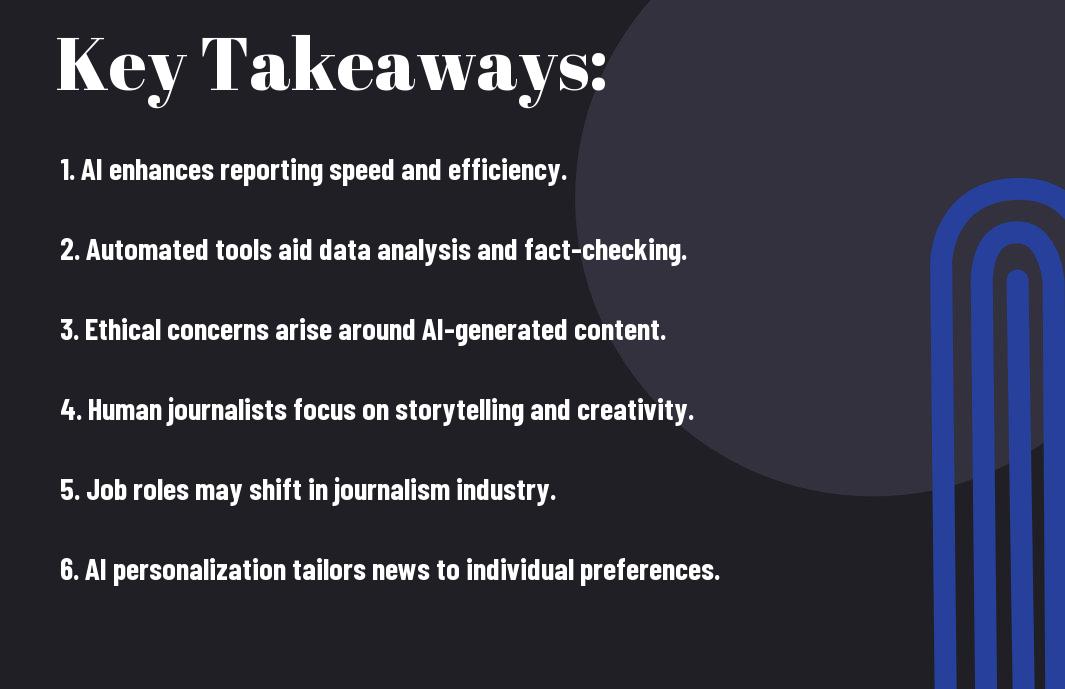
Even in its early stages, the integration of AI in journalism offers considerable advantages. Automated tools help streamline content creation, reducing the time you spend on repetitive tasks. This technological advancement not only increases productivity but also allows you and your team to focus on storytelling and creative aspects of journalism. By leveraging machine learning and natural language processing, AI can support your endeavors in producing timely and accurate news, enhancing both the quality and accessibility of information.
Enhanced Reporting Efficiency
Along with saving time, AI facilitates more efficient reporting by automating mundane tasks such as data entry and verification. This allows you to allocate more resources to investigation and analysis. With AI tools analyzing news elements in real time, you can ensure that your coverage remains relevant and responsive to fast-changing events and stories.
Improved Data Analysis
An important advantage of AI in journalism lies in its enhanced data analysis capabilities. Advanced algorithms can sift through vast amounts of information quickly, identifying trends and patterns that may not be immediately apparent. This ability equips you to uncover deeper insights and build more compelling narratives based on real-time data.
For instance, when covering complex topics like economic trends or public health issues, AI can analyze datasets to reveal correlations and causations that support your reporting. By harnessing AI-powered analytics, you can provide more comprehensive context for your stories, sparking greater interest and engagement among your audience. This level of detail not only enhances the depth of your reporting but also establishes your credibility as a journalist committed to delivering informed content.

Challenges and Ethical Considerations
To navigate the integration of AI in journalism, you must confront various challenges and ethical dilemmas. Issues such as job displacement, bias in algorithmic outputs, and maintaining credibility demand your attention as journalists adapt to this evolving landscape. You need to reflect on your responsibility to uphold ethical standards while leveraging technology to enhance storytelling.
Job Displacement Concerns
Among the most pressing issues related to AI in journalism are the concerns about job displacement. As AI systems become more adept at generating articles and news summaries, there is fear that human journalists may find their roles diminished or even obsolete. You should consider how this trend may impact your career and the broader industry, balancing the potential benefits of efficiency with the human touch that resonates with audiences.
Issues of Bias and Credibility
Above all, you should be aware of the potential biases inherent in AI systems and the importance of maintaining credibility in journalism. AI algorithms are trained on existing data, which can perpetuate existing biases or inaccuracies. This raises significant ethical questions about the reliability of AI-generated content, challenging your duty to provide fair and accurate information to your audience.
Considerations regarding bias and credibility are vital as you embrace AI in journalism. You must scrutinize the data used to train AI systems, as biased input leads to biased outputs, undermining the integrity of your work. Ensuring transparency in how AI tools are utilized and fostering a culture of accountability will be pivotal in maintaining trust and credibility with your audience. Ultimately, your commitment to journalistic ethics will define how AI complements, rather than compromises, your role in informing the public.

Case Studies of AI in Journalism
Unlike traditional journalism, which relies heavily on human effort, AI has successfully integrated into various newsrooms, enhancing efficiency and accuracy. Here are some notable case studies:
- The Associated Press generated over 3,700 earnings reports in 2014 using AI, significantly reducing the time taken for financial news coverage.
- Reuters employs AI-driven tools to produce automated reports during breaking news, allowing for up-to-the-minute updates.
- Bloomberg uses its AI software, Cyborg, to analyze data and generate concise financial reports, aiding in faster decision-making for clients.
- Local newspapers in the U.S. utilize AI for generating sports reports, saving reporters hours of work each week.
Successful Implementations
Alongside these advancements, news organizations have highlighted successful implementations of AI, demonstrating its potential to reshape how stories are told. For example, AI-generated articles have improved report turnaround time by up to 50%, enabling journalists to focus on in-depth investigations while routine reporting is automated.
Lessons Learned
To fully understand the implications of AI in journalism, it’s necessary to analyze the lessons learned from these case studies. Organizations have recognized the importance of maintaining ethical standards and transparency while adopting AI technology.
Considering the expanding role of AI, media professionals must adapt to ensure that innovation aligns with journalistic integrity. Your focus should be on utilizing AI as a tool to enhance storytelling while upholding factual accuracy. Additionally, emphasizing collaboration between AI systems and human writers can lead to richer content, as the human element remains paramount in engaging audiences. Balancing technology with public trust is vital for fostering a sustainable future in journalism.
The Future of AI in Journalism
Your understanding of journalism will be redefined as AI continues to evolve, influencing not just how news is gathered but also how it is produced and consumed. With machine learning algorithms improving at a rapid pace, expect AI to take on more complex roles in newsrooms, enhancing accuracy and personalization in reporting. As you navigate this landscape, be prepared for significant changes in how information is disseminated and curated, enabling a more efficient flow of news to audiences worldwide.
Predictions for Industry Transformation
After years of gradual change, the journalism landscape will likely undergo a seismic shift fueled by AI technologies. You can anticipate enhanced data analysis capabilities that will streamline the reporting process, enabling journalists to focus more on storytelling rather than data collection. As AI becomes a staple in newsrooms, it is predicted that the industry could see an influx of tailored content designed to meet the specific preferences of diverse audience segments.
Potential for New Journalism Models
Future journalistic practices are poised to evolve dramatically with AI integration. You have the chance to witness the emergence of new models that blend traditional journalism with innovative technologies, allowing for interactive storytelling and real-time reporting. This transformation could facilitate collaboration between journalists and AI tools, fostering a new wave of investigative reporting that tackles complex issues efficiently.
This shift towards AI-driven models will open doors for hyper-local news initiatives, automated content creation, and enhanced reader engagement. You may find that new journalistic practices can leverage AI to source information quickly, analyze vast datasets for trends, and even provide personalized news experiences. This evolution not only enriches the reader’s experience but may also disrupt existing business models in journalism, propelling the industry into uncharted territory. As you explore these advancements, consider how they might influence your connection to the news and the role that technology plays in shaping public discourse.
Conclusion
Following this exploration of the rise of AI in journalism, you should recognize its potential to transform the industry significantly. As AI tools continue to evolve, they will impact your news consumption and production, enhancing efficiency while raising ethical considerations. You have the opportunity to engage with these advancements thoughtfully, ensuring that the essence of journalism remains intact while embracing innovation. Your understanding of this shift will empower you to navigate the future landscape of media with a critical eye and informed perspective.